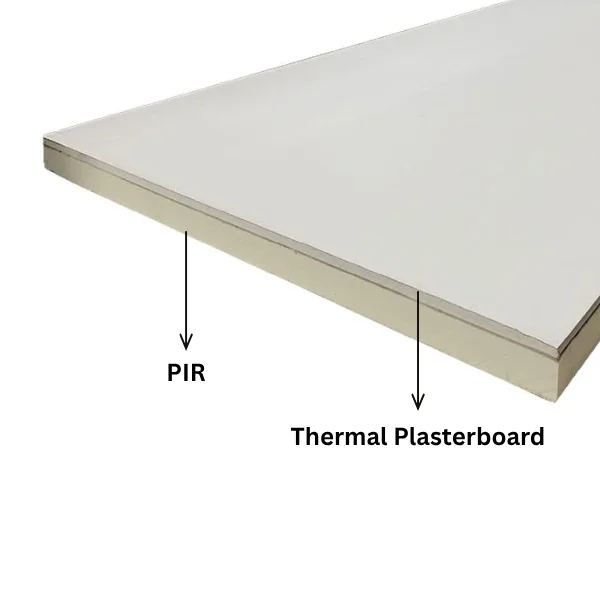
PIR Insulated Plasterboard 2400mm x 1200mm
PIR Insulated Plasterboard is a dual-purpose thermal lining board combining rigid PIR insulation with a tapered-edge plasterboard ready for finishing on internal walls and ceilings.
Description
PIR Insulated Plasterboard combines a high-performance PIR core with a bonded lining to create a single thermal drylining board. The rigid insulation core delivers strong thermal resistance and helps reduce heat loss across masonry, timber and metal frame constructions. The plasterboard face provides a smooth, finish-ready surface for skim coating or direct decoration.
A factory-bonded foil layer enhances vapour control and supports condensation management in internal environments. This stable composite layer maintains thermal efficiency and dimensional accuracy once fixed to substrates. The board reduces installation time by removing the need for separate insulation and plasterboard layers in new-build and refurbishment projects.
This product suits designers and installers aiming for low U-values, controlled moisture behaviour and a rapid interior lining process. It integrates well with drylining systems and supports efficient thermal upgrades in domestic or commercial spaces.
Installation Guide:
Prepare clean, dry internal surfaces before fixing
Fix boards using adhesive dot-and-dab or mechanical fixings based on substrate
Treat tapered joints with tape and jointing compound for a smooth finish
Cut by scoring the plasterboard face and snapping cleanly; use a fine saw through PIR if needed
Keep boards dry before installation and protect from prolonged moisture exposure
PIR vs EPS vs XPS vs Phenolic (Quick Comparison)
PIR, EPS, XPS, and Phenolic Foam are four major rigid insulation types used in walls, floors, roofs, and façades, each offering different thermal performance, moisture behaviour, strength, and cost.
-PIR Insulation (Polyisocyanurate)
PIR offers strong thermal performance with a conductivity around 0.022 W/mK, making it thinner for the same U-value than EPS or XPS. It includes a foil facer for vapour control and stable performance in warm-roof, drylining, and cavity wall systems. PIR works well when space is limited and compliance with Part L is required. It performs reliably in floors, roofs, and framed walls.
-EPS Insulation (Expanded Polystyrene)
EPS is lightweight, cost-effective, and easy to cut. Thermal conductivity is typically 0.030–0.038 W/mK, making it thicker than PIR for the same thermal target. EPS is breathable and commonly used in EWI systems, under-slab insulation, and packaging-like applications where cost efficiency matters. It absorbs more moisture than PIR or XPS, so detailing must control damp exposure.
-XPS Insulation (Extruded Polystyrene)
XPS delivers strong compression strength and low moisture absorption. Conductivity is typically 0.033–0.037 W/mK. It suits load-bearing environments such as inverted flat roofs, ground slabs, basements, and perimeter insulation. Its closed-cell structure resists water ingress, making it reliable in wet or high-pressure conditions. XPS is generally more durable than EPS but thicker than PIR for thermal targets.
-Phenolic Foam Insulation
Phenolic foam achieves the highest insulation performance in common rigid boards, with conductivity around 0.018–0.020 W/mK. It delivers very low U-values with minimal thickness, useful in tight retrofit spaces and façades. It offers excellent fire behaviour due to its char-forming characteristics when exposed to heat. Phenolic boards can be more brittle than PIR and cost more, but give maximum efficiency when thickness is restricted.
Related Products
Browse all products to find more items in this category.