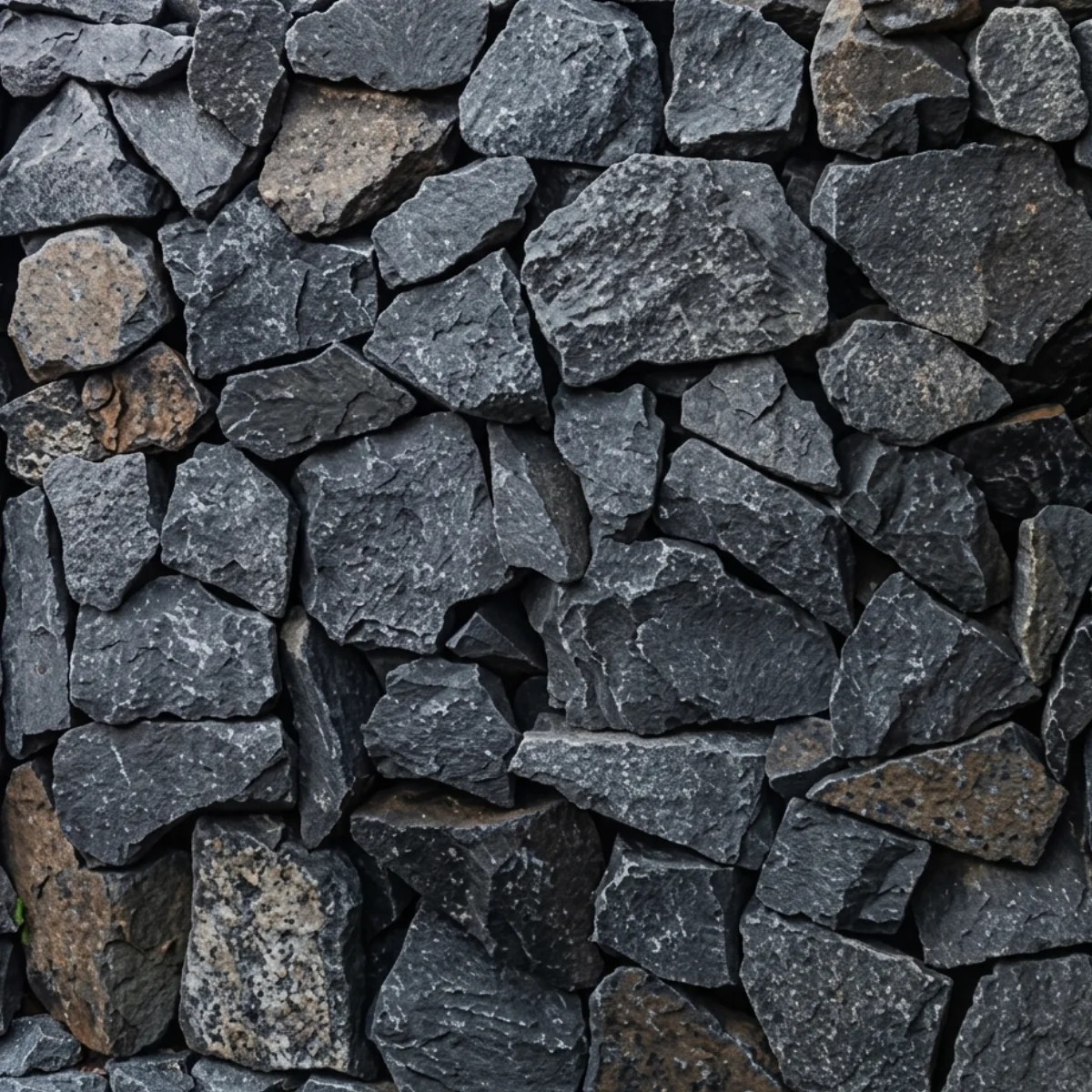
100-150mm Charcoal Basalt Gabion Stone
Charcoal Basalt Gabion Stone 100–150mm is a hard volcanic rock with a dark grey to black finish, designed for gabion baskets, retaining walls and erosion control.
Description
100-150mm Charcoal Basalt Gabion Stone is a natural basalt aggregate graded between 100mm and 150mm. It is produced from crushed igneous rock and supplied with low fines content for structural containment use.
The stone is dense and angular, promoting strong mechanical interlock within gabion baskets. It is exceptionally strong and weather resistant, supporting long-term stability in retaining and erosion control structures. The material is fish friendly, low maintenance, and suitable for exposed environments.
The stone appears dark grey when dry and deep black when wet, providing visual contrast in landscaping and architectural works. The 100-150mm grading is a recognised UK gabion specification, balancing stone retention, drainage performance, and visual consistency across domestic, commercial, and civil engineering applications.
Material Classification and Grading
This product is a single-sized coarse aggregate graded at 100-150mm. It falls within large stone categories used for containment systems. The grading supports void formation and stone interlock.
Large nominal size supports basket retention.
Controlled grading limits oversize stones.
Low fines content maintains voids.
Consistent sizing improves installation efficiency.
Basalt as a Gabion Stone Material
Basalt is a dense volcanic rock valued across the UK construction and landscaping sectors for its strength, durability, and resistance to weathering.
Key Properties of Basalt
High compressive strength
Low water absorption
Excellent resistance to frost and freeze-thaw cycles
Maintains structural integrity under sustained load
Because of these characteristics, basalt is regarded as a premium material for gabion stone, particularly where long-term performance is required.
Structural Performance
The stone provides mass and interlock within gabion systems. Load is transferred through stone-to-stone contact. This supports stable retaining structures.
Angular faces improve mechanical locking.
High density increases wall mass.
Stone friction resists movement.
Large size reduces internal settlement.
Why 100-150mm Stone Size Is Used for Gabions
Stone size is a critical engineering consideration in gabion construction, not simply an aesthetic choice.
Advantages of the 100-150mm Size Range
Reduces the risk of stone loss through basket mesh
Promotes strong interlocking within the cage
Minimises long-term settlement
Provides sufficient mass for retaining and load-bearing structures
Smaller stones may escape through the mesh, while significantly larger stones can make packing difficult and compromise the finished appearance.
Drainage Performance of Basalt Gabion Stone
One of the principal advantages of gabion systems is their inherent drainage capability.
Drainage Benefits
Water flows freely through voids between stones
Hydrostatic pressure does not build up behind walls
Reduced need for additional drainage infrastructure
Increased lifespan of retaining structures
Basalt gabion stone supports this function effectively due to its consistent grading and low fines content.
Long-Term Durability & Weather Resistance
Basalt performs exceptionally well in the UK climate.
Long-Term Behaviour
Resistant to cracking and degradation
Minimal colour change from UV exposure
Performs reliably through repeated freeze-thaw cycles
Low maintenance over its service life
These qualities make basalt gabion stone suitable for both residential and large-scale civil engineering projects.
Gabion Basket Compatibility (Mesh & Aperture Size)
Correct compatibility between stone size and basket mesh is essential.
Recommended Basket Aperture
For 100-150mm gabion stone:
Typical mesh aperture: 75 × 75mm or 100 × 100mm
Stone size should exceed mesh aperture by at least 1.5 times
This ensures a neat finish and prevents stone loss during installation and use.
Use in Retaining Wall Systems
100-150mm charcoal basalt gabion stone is widely used in retaining wall construction.
Retaining Wall Advantages
Provides significant structural mass
Naturally resists lateral soil pressure
Combines strength with effective drainage
Can reduce reliance on reinforced concrete solutions
This makes gabion walls a practical and visually appealing alternative in many UK projects.
Standards and Compliance
Gabion stone is commonly supplied in line with UK aggregate supply practices. It is suitable for use in civil and landscaping applications where large stone is specified. Compliance depends on source and project specification.
Suitability and Usage Limitations
Suitable For
Gabion basket wall construction.
Retaining wall systems.
Riverbank and channel protection.
Erosion control structures.
Landscaping feature walls.
Not Suitable For
Decorative surfacing.
Path or driveway surfaces.
Concrete production.
Bedding or levelling layers.
Areas requiring fine compaction.
Application Suitability Reference
Application | Suitable | Reason |
|---|---|---|
Gabion walls | Yes | Correct size and angular shape |
Retaining structures | Yes | High mass and interlock |
Riverbank protection | Yes | Durable and free draining |
Drainage trenches | No | Stone size too large |
Pavements | No | Cannot be compacted |
Concrete aggregate | No | Oversized grading |
Supply Formats & Bulk Availability
100-150mm charcoal basalt gabion stone is typically supplied in the following formats:
Loose bulk delivery by tipper
1-tonne bulk bags
Project-specific bulk quantities
Bulk supply is generally the most cost-effective option for large installations.
Basalt vs Limestone Gabion Stone
Strength and Durability
Basalt: Very high strength, long service life
Limestone: Softer material, weathers more quickly
Colour Retention
Basalt: Stable, dark colour over time
Limestone: More susceptible to staining and discolouration
Maintenance
Basalt: Low maintenance
Limestone: Moderate maintenance
For structural and long-term applications, basalt is generally the preferred choice.
TradeSupermarket - UK Supply and Hire Platform
TradeSupermarket is a UK-based platform supplying plant hire, aggregates, and building materials for a wide range of project types nationwide. Products and services are structured in line with recognised UK classifications and standard supply and hire practices.
What Sets TradeSupermarket Apart
Unified Platform Structure: Hire services, aggregates, and building materials are all managed through one unified system instead of separate suppliers.
Classification-Led Organisation: Products are shown using standard UK grades, categories, and typical use-cases to help buyers choose accurately.
Defined Supply Scope: The platform focuses on supplying materials and equipment in a clear, straightforward way, without adding design or installation services.
Use-Case Neutral Positioning: Products are suitable for home, commercial, and large-scale projects without assuming a specific type of customer.
Consistent Operational Standards: All product categories follow clear, uniform processes to ensure a steady and reliable experience every time.
Supply and Delivery Responsibility
Material Variation: Aggregates are natural or recycled materials and variation in colour, shape, and composition can occur between sources and deliveries.
Quantity and Coverage: Materials are supplied by weight or volume as ordered. Coverage, yield, and performance are influenced by application method and ground conditions.
Delivery and Site Access: Delivery requires suitable access for the selected vehicle type. Clear access, adequate space, and stable ground conditions must be available at the delivery location.
Offloading Conditions: Materials are offloaded at ground level only. Placement, spreading, or installation services are not included as part of supply.
Returns and Surplus Material: Bulk aggregates are non-returnable once delivered. Customers should ensure quantities are calculated accurately before placing an order.
Supply Scope: Supply is limited to the provision of materials only. Product selection, suitability assessment, and installation remain the responsibility of the buyer or appointed contractor.
Related Products
Browse all products to find more items in this category.